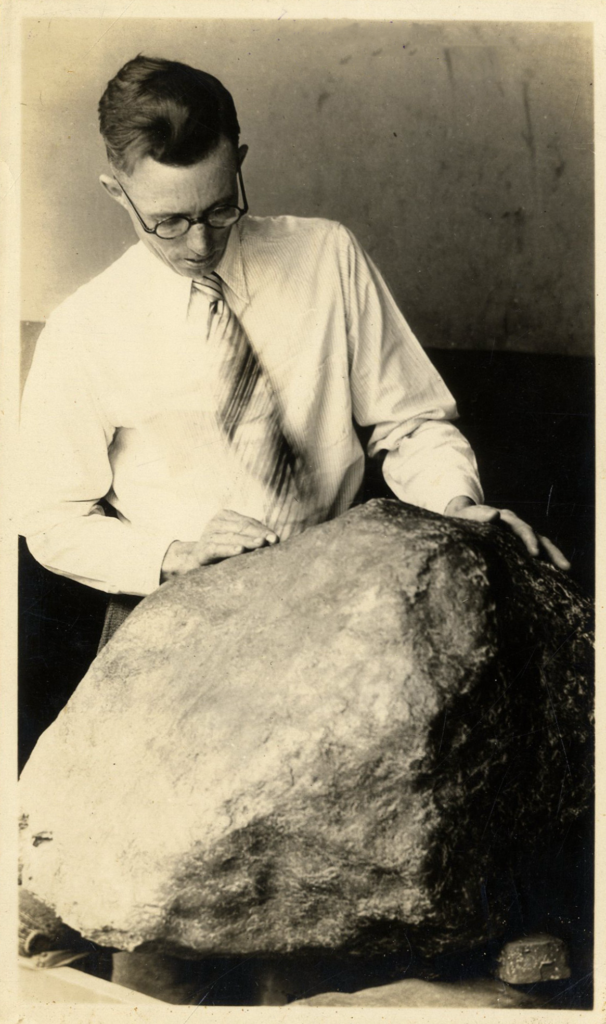
On the evening of November 9, 1923, H. H. Nininger witnessed a brilliant fireball over McPherson, Kansas. The event changed the course of his life and set him on a pursuit of meteorites that would continue for more than half a century. Nininger later described that pivotal evening in his autobiography:
On the evening of November 9, 1923, faculty and students gathered in the chapel for a lecture, play, chorus or some other of the programs common to college communities. At the close of the program I walked toward home with my friend, Professor E. L. Craik. We paused in front of his house to chat. Astronomy didn’t enter our conversation. Had anyone asked, I could have told them that we were sailing along in our orbit at about eighteen-and-a-half miles per second, that our town and college along with all the rest of the earth’s surface were in normal rotation about its axis at a little less than a thousand miles an hour. But I surely could not have told that a meteorite only a few thousand miles away was following a course that within minutes would mean the extinction of this minor member of the solar family before our very eyes and at the same time would start a metamorphosis in the life of a young biologist.
Suddenly a blazing stream of fire pierced the sky, lighting the landscape as though Nature had pressed a giant electric switch. The blade of light vanished with equal suddenness, leaving a darkness seeming thicker than before.
Momentarily Professor Craik was speechless. Then he saw that I was bent over, making a mark on the sidewalk. He asked me what I was doing. I remember telling him I was going to find that meteorite and that I was plotting its path from where I saw it. He laughed, but I was serious.
—H. H. Nininger, In Search of Falling Stars
Nininger identified the vicinity of Coldwater, Kansas, as the likely area of the fireball’s fall. He eventually recovered two unrelated meteorites (one stony and one iron) from the vicinity, though he later concluded that neither of them was from the November 9 fireball. However, the methods he developed while pursuing that fireball—educating the public about meteorites and enlisting the help of local residents and the press, would become central to the remainder of his career.
The complete story of Nininger’s search and the remarkable career that followed is told in In Search of Falling Stars.